
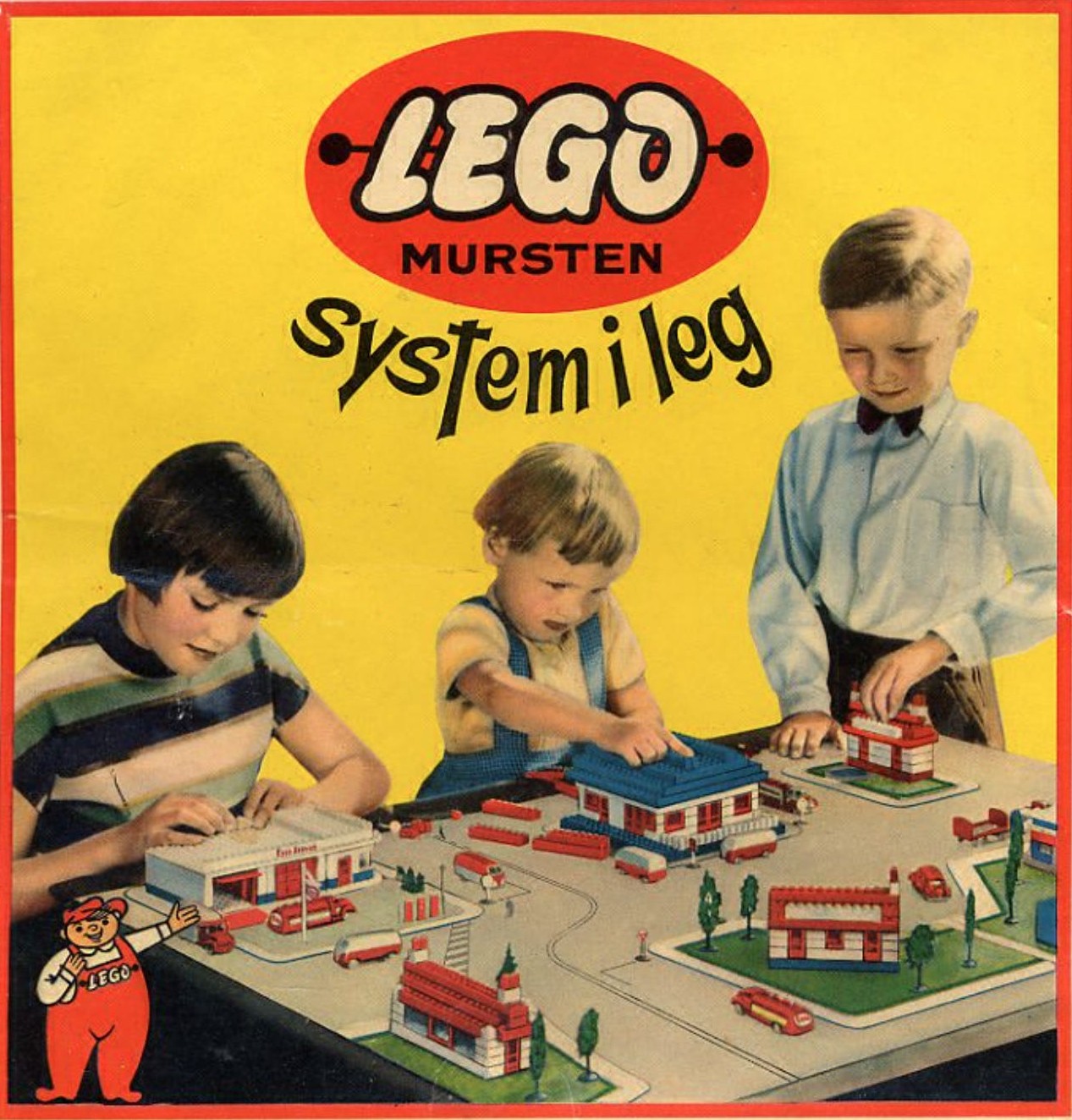
LEGO System of play
1953
The LEGO System of Play is the fundamental philosophy and design principle that governs all LEGO products, ensuring that nearly all bricks and elements across different sets and themes are intercompatible and connectable.
This concept was formally introduced in 1955 and is built around the idea that every piece should fit together, allowing a child's collection to grow into a unified, versatile creative toolbox.
The Core Philosophy
The System of Play ensures that a brick purchased in the 1960s will connect with one purchased today. The core idea is based on five guiding principles:
System: All components fit together seamlessly.
Number: The system uses a specific "module" dimension for everything.
Combination: The system is based on the idea that any two bricks can be joined in countless ways. A single 2x4 brick can, in theory, be combined with six 8-stud bricks in over 915 million ways.
Integration: New elements added to the system must fit with existing elements.
Logic and Coherence: The entire system is rational and adheres to a predictable structure.
Key Components
Stud-and-Tube Coupling: The patented design (1958) that provides the "clutch power" (friction fit) holding the bricks together securely.
Modular Dimensions: Everything is based on a fundamental unit of measurement (the "LEGO Module"), ensuring that a door from a Town set fits into a Castle wall, and a wheel from a Technic set can be integrated into a Creator model.
Theme Integration: While sets are organized into themes (City, Space, Castle, etc.) to inspire specific types of play, the underlying bricks remain compatible, allowing builders to combine elements from different worlds.
The LEGO System of Play transformed the LEGO brick from a simple toy into a creative medium, providing a universal language for building and design that has endured for decades.